Paths to Peace


Thursday, December 17, 2009

A Famous Christmas Song Born During the Cuban Missle Crisis


Sometimes the deeper significance of the Christmas holiday gets lost in all of the comercial excess in December.


Here is the story of how one of the most popular Christmas songs was born at a time when the world was on the brink of nuclear war. The song is a reminder to stop war and embrace love.


"Do You Hear What I Hear" one of the world's most beloved Christmas songs was born during the Cuban Missile Crisis in 1962 as an anti-war statement by a former French Resistance fighter from WWII who had personally suffered the ravages of war.


Noel Regney (1922-2002) was a Frenchman trained as a classical composer who was drafted into the German army in World War II. He deserted and joined the French Resistance. [During his work with the Resistance he suffered the horrors of war directly: he was shot, but survived.] After the war ended, Regney joined the French Overseas Radio Service and worked out of French Indochina until moving to Manhattan in 1952. He met Gloria Shayne while she was working as a pianist in a hotel dinning room and married her a month later.


Regney and Shayne wrote "Do You Hear What I Hear" in 1962 during the Cuban Missile Crisis. Regney drew the image of Jesus as a newborn lamb from Matthew 2:9 and 2:11 and took his lyrics to his wife to set in the reverse of their usual practice. But while it is often taken for a Christmas carol, for Regney and Shayne "Do You Hear What I Hear" is a hymn to peace. "I am amazed that people can think they know the song," Regney later said, "and not know it was a prayer for peace." Although the song has been recorded by Bing Crosby and Perry Como and over 120 others, Regney and Shayne's favorite recording was Robert Goulet's 1963 recording for its dramatic delivery and his climatic "Pray for peace, people everywhere." ~ James Leonard, All Music Guide

Here's a link to the Bing Crosby version of "Do You Hear What I Hear"


And here are the lyrics:


Do You Hear What I Hear?


Said the night wind to the little lamb,


do you see what I see


Way up in the sky, little lamb,


do you see what I see


A star, a star, dancing in the night


With a tail as big as a kite


With a tail as big as a kite


Said the little lamb to the shepherd boy,


do you hear what I hear


Ringing through the sky, shepherd boy,


do you hear what I hear


A song, a song, high above the trees


With a voice as big as the sea


With a voice as big as the sea


Said the shepherd boy to the mighty king,


do you know what I know


In your palace warm, mighty king,


do you know what I know


A Child, a Child shivers in the cold


Let us bring Him silver and gold


Let us bring Him silver and gold


Said the king to the people everywhere,


listen to what I say


Pray for peace, people everywhere!


listen to what I say


The Child, the Child, sleeping in the night


He will bring us goodness and light


He will bring us goodness and light


Monday, December 14, 2009

Lessons We Can Learn from Peacemakers in the 5th Grade


I am serving as a volunteer mentor this winter in a special program called SPAVA that allows me to share non-violent conflict resolution skills with 5th graders at Bates elementary school in Louisville. You can find details about SPAVA (and volunteer for the program) at http://www.spava.us/.
One young student in my class shared an idea with me last week that I found deeply moving and full of creativity well beyond the years of this young person.

I had given my 29 students a take home assignment. I asked them to think of a major problem in the world that they would like to solve and then describe a machine that they would create to address that problem.

Wonderful ideas were shared by these 5th graders about how to eliminate hunger, cure diseases, and provide housing for everyone in the world, but one idea in particular grabbed my attention. It related to anger.


Anger is one of the major problems for students in our public schools. Probably all students feel anger. In fact we tell them it's ok to feel angry. But these fifth graders (like the rest of us) get into trouble when they respond to their anger by acting impulsively, without thinking.

So we teach them how to use a method pioneered by SPAVA called STAR.

In the STAR method students take 4 key steps to solving their problems non-violently these are:

S STOP! Cool down so you don’t do something impulsive that you
may regret later. Take a deep breath and count to 5 or do something else that works for you.
T THINK! What is the real problem? What are your choices? Ask about each choice: Does it respect everyone? Will it work? Pick your best choice.
A ACT! Carry out your best choice.
R REVIEW! Ask yourself, “Did it work? If it did, great! If it didn't, try another choice.

The students hadn't yet learned the STAR method when I gave them the assignment to address a major problem in the world. In spite of that, one young woman came up with an idea that was a perfect reflection of what we hope for through STAR.

She shared with me and members of her class that destructive anger was the problem she wanted to eliminate. She "invented" a machine that would sense your anger and turn it into beautiful music that would soothe you and calm you down. I love that idea. And I wish we had more inventors like my young friend.

And again, here is a link to information about SPAVA. I hope you will become a mentor in this brilliant program.

Thursday, December 10, 2009

Ashokan Farewell: Honoring the memory of dead friends and relatives


Last Thursday was the 41st anniversary of the death of Thomas Merton. Interfaith Paths to Peace and St. William Church here in Louisville hosted a noontime vigil for peace in Afghanistan that day to mark the anniversary.


But as I look back, last week was one that was filled with death and the reminders of death.


Last Monday night I participated in the annual Memorial Service of Mothers Against Drunk Driving. The service honors the memory of those killed in the last year by drivers who were under the influence of alcohol or drugs. That event was attended by about 120 survivors and family members of those being remembered. It also was attended by over 200 people who are part of a diversion program operated by our county prosecutor's office. This program directs offenders to attend the memorial service as a way of reminding them what the results of drunk driving can be. I found the service deeply compelling for two reasons: my Uncle Mac was killed by a drunk driver when I was 10; and though I have never been arrested for drunk driving, I am a recovering alcoholic .

Other things served as reminders too.

One was last Wednesday's noontime meditation. I lead a noontime meditation once a month built around the concept of "Lectio Divina" a meditation that can take people into a deeper understanding of scripture and sacred stories from the world's many religions. The story we meditated on this last Wednesday was very much concerned with how we deal with our memory of the dead. Here's what we read:

Many African societies divide humans into three categories: those still alive, the sasha, and the zamani. The recently departed whose time on earth overlapped with people still here are the sasha., the living dead. They are not wholly dead, for they live in the memories of the living who can call them to mind, create their likeness in art, and bring them to life in anecdote.

When the last person to know an ancestor dies, that ancestor leaves the sasha for the zamani, the dead.

As generalized ancestors, the zamani are not forgotten but revered. Many can be recalled by name. But they are not living dead.

--the epigraph from the book, The Brief History of the
Dead


A final jolt came when I learned on Thursday afternoon that the 52 year old husband of a friend had died suddenly of a heart attack that morning. The weekend was filled with services and preparations for meals aimed at easing the grief of the widow and her sons.

To honor Merton and all of the dead I have been thinking about, I offer here a link to the song, Ashokan Farewell. The link contains not only the tune but also the composer telling the story of how the song came to be. I first heard it years ago whenI watched the Ken Burns documentary about the Civil War. In the documentary it was a repeated motif reflecting the grimness of war and violence. The tune is sad, and sounds like a longing for home, or a lament for a lost love, or the bittersweet memory of those we miss.


Wednesday, December 2, 2009

President Obama's New Plans for Afghanistan

Yesterday afternoon I received a call from Peter Smith, religion reporter for our local newspaper, the Louisville Courier-Journal. Peter had been given the task of contacting individuals representing local peace groups for reactions to the President's speech later that evening on his plans for sending more troops to Afghanistan.


My comments were included in the article which appeared this morning. Here is a link:


http://www.courier-journal.com/article/20091201/NEWS01/912010362/Military+action+alone+won+t+solve+Afghanistan+s+problems++Louisville+residents+say


I said that I had hoped that with the coming of a new administration we would be looking for peaceful ways to solve our differences with other countries. I commended the President on having a clearly set out exit strategy (although I said I would have been happier if he were pulling our troops out sooner).


There is something I didn't say there that I would like to say here. I am generally opposed to wars and violence of all kinds. But for those who plan and execute wars, there is something that should be remembered. Undertaking a war without a clear understanding for leaders and the public alike of what would constitute winning (and loosing) leads to disaster. We saw that in Vietnam. We witnessed it again in Iraq. I fear that once again we find ourselves mired in a conflict that will hold onto us with a death grip because we can't clearly explain, simply explain what it would mean to win in Afghanistan.


I think the best strategy is to get out. Now.

Tuesday, November 10, 2009

The Often Unheard Voice of Muslims Denouncing Violence


Last night I attended the second annual dinner of the Council of Islamic Organizations of Kentucky (CIOK). The dinner program (which was attended by hundreds of people, including Jews and Christians) began with a moment of silence honoring the victims of the massacre that occurred at Ft. Hood last week.

What is remarkable about that is that I often hear people say that Muslims don't acknowledge or denounce violence committed by members of their religion.

In fact they do, and they are speaking out more forcefully and more frequently.

There was an article in last Friday's Courier-Journal in which reporter Peter Smith asked local, regional and national Islamic leaders for comments about the horrifying shootings in Texas. Without exception they all denounced the violence and indicated that no true practitioner of Islam would undertake such a despicable act. Those interviewed included leaders of Louisville-area Mosques (among them, a member of my organization's board: Bashar Masri), the Council of Islamic Organizations of Kentucky, and the Islamic Society of North America (the major national affiliate group for Muslims) among others.

Here is a link to Peter Smith's article, so you can read for yourself.

http://www.courier-journal.com/apps/pbcs.dll/article?AID=2009911060348

In the recent past the news media often seemed to report only negative things about Muslims. That is starting to change, and I congratulate Peter Smith and the Courier-Journal for seeking out articulate Muslim leaders to help us understand how Muslim Americans really feel. Moreover, the recent statements by mainstream American Muslims underscore for me the fact that our Muslim brothers and sisters each day are moving more deeply into the mainstream of American life and that they embrace the kind of peacemaking values all of us espouse. Or maybe it's just that we are finally beginning to hear about Muslim values and opinions that have been there all along. I suspect the latter is the case.


Friday, October 30, 2009

A Special Interfaith Blessing


Yesterday evening I had the privilege of offering the opening blessing at the annual interfaith dinner in Louisville sponsored by Highlands Community Ministries. The dinner included presentations on the topic of "What is Happiness", delivered by representatives of the Baha'i faith, Judaism, Christianity, Islam, Hinduism, and Buddhism.
As I prepared this prayer, I apprached it by delving deeply into the core
of each of these religions not so much with my brain as with my heart. I humbly
share the result with you:

Friends,

The great interfaith leader Mathew Fox uses a wonderful metaphor to describe the relationship between God and the world’s great religions. He says that the Divine is like a great underground river and that each of the world’s religions digs its own well to tap into the beauty and power of the Divine.

Recognizing both the diversity and unity of
those of us gathered here
tonight, we call upon the Divine to bless this
gathering and the food we are
about to eat,

In the name of:
  • Our Baha’I friends who possess such a profound understanding of our
    universal oneness,

  • Our Buddhist brothers and sisters with their great concern to end the
    suffering of all beings,

  • Our Jewish companions and their invocation of the concept of Tikkun Olam to
    mend our broken world,

  • Our Hindu comrades and their realization that the Transcendent has many
    faces and can be approached in different ways,

  • Our Christian partners who so powerfully incarnate God’s love for the world
    through the corporal acts of mercy,

  • Our Muslim neighbors who believe that submitting to God’s will means working
    for peace and justice,

  • And the practitioners of other religions in the greater Louisville area who
    so richly reflect the diversity of our world.

    Amen

Thursday, October 29, 2009

Jews are (sadly) a Ghostly Presence in the Arabic Middle East


(As a result of a trip I made to Egypt and Syria in 2008, I was recently asked to write a chapter for a forthcoming book that will include the thoughts of a number of people who have made trips from the US to the Middle or from the Middle East to the US. What follows is a version of what will be appearing in the book)

Jews are a ghostly presence in the Arabic Middle East. That is a sad reality I experienced first-hand when I visited Egypt and Syria in June of 2008 as part of the Religion and Society Program as a guest of the Natioanl Peace Foundation and the Islamic Society of North America. My group included one American Muslim, two Jews (including a young Rabbi from Texas), and three Christians .

During our ten-day stay we had scores of meetings with groups, organizations and religious communities. Wherever we went we heard universal, unanimous affirmation of the idea of interfaith cooperation, especially among Muslims, Christians and Jews. In spite of that there was one event that focused me on what I think is the key problem in interfaith understanding among members of the three Abrahamic religions.


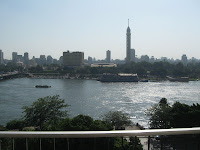
We had only been in Cairo for a couple of days when our group was taken to visit Shaar Hashamaim Grand Synagogue of Cairo in that great Egyptian city. The morning we arrived it wasn’t the Sabbath. We explored this beautiful spiritual facility as though it were a museum. There were many things I wanted to know about it, and I began to pepper our tour leader with questions. She smiled and pointed me toward an Egyptian gentleman who she told me was the caretaker for the building.


I walked over to him, and began asking what I thought was going to be a series of questions about the building’s history by saying, “I understand that you are the caretaker for this synagogue…” Before I could get to my first question, he said, “Actually, I am the caretaker for all of the synagogues in Egypt.”

That seemed pretty impressive to me, given that Egypt is a fairly large country geographically and it has a population of about 80 million. So I asked, “And how many synagogues are there in all of Egypt."

Without hesitating, he responded, “Eleven. Five of them here in Cairo.” Again, I was impressed but wanted to learn more, so I asked, “And how many Jews are there in Egypt?”
“One Hundred and Eighty,” he said.


I thought I had misunderstood him, and I said “One hundred and eighty thousand?”
“No,” he said, “only one hundred and eighty. And they are all women and they are all old.”
I was stunned. I had no idea that there were so few Jews in Egypt. A few days later when we visited Damascus, I discovered there was an equally tiny number of Jews remaining in all of Syria. After I returned to the U.S., I did a little Google searching about the Jews in Arab countries. I learned that with the exception of Morocco, and perhaps Algeria, there are virtually no Jews in the Arabic speaking Islamic world.

The tiny, spectral presence of the Jews around the Mediterranean represents a major problem that must be addressed if we are to establish a long lasting peace in the Middle East.
The problem is that when you don’t have daily, on going contact with “the other,” whether they are Jews or Muslims (or Buddhists for that matter), it is very easy to demonize those who aren’t present. Lack of contact often leads one party into beliefs and practices that escalate into violence. We see this over and over again, whether it is in Israel and the Occupied West Bank, Ireland, or in Louisville, Kentucky where I live in the US.


Shortly after I returned from the trip to Egypt and Syria I had lunch with my friend Sylvia Weinberg, an emerita member of my group’s Board of Directors. Sylvia is an accomplished poet and one of those rare people who can listen to a story or problem and put her finger right on the heart of the issue being discussed. Because of this I frequently seek her counsel.
Over lunch I told her about the trip I had made to the Middle East. I talked about all of the incredible people we had met and the extraordinary historical sites we had visited. I concluded my travelogue with the story of visiting the historical synagogue and I mentioned the tiny number of Jews in the Arab Middle East. I talked about the enormous obstacles this puts in place for those of us working to increase understanding.


When I had finished telling my story, Sylvia paused for a moment and said, “Does that make you despair of your work as an interfaith leader?”

Up to that moment I hadn’t really thought about the impact of what I had seen on my own work.
So then I paused and considered her question carefully. When I answered, what I told Sylvia surprised me. I said, “No, I don’t feel despair about the fact that there is little opportunity for interaction between Muslims and Jews in Arab countries. This fact just shows me that our work to improve interfaith interaction and understanding is a growth industry. I will be working at this for years to come.”


And that is true for me as well as for other interfaith entrepreneurs. It doesn’t make any difference, really, whether we are in Cairo, Egypt, or Cairo, Illinois. There is still a great gulf of misunderstanding, or more accurately, ignorance, that separates people of different religions, whether they are Christians, Jews, Muslims, Hindus, Baha’is or Buddhists. The work of bringing people of different religions together is an incredibly important endeavor. Without daily interfaith encounters, the door is open to misunderstanding, mistrust, vilification and ultimately violence. That is why inter-cultural trips such as those undertaken by the National Peace Foundation and the Islamic Society of North America are so valuable not only for those who take the excursions, but also for those with whom we share our stories when we return home.